
Global MCap:
24h Volume:
BTC Dominance:
ETH Dominance:
Fear & Greed:

Global MCap:
24h Volume:
BTC Dominance:
ETH Dominance:
Fear & Greed:
Published November 26, 2026
• Updated November 26, 2026
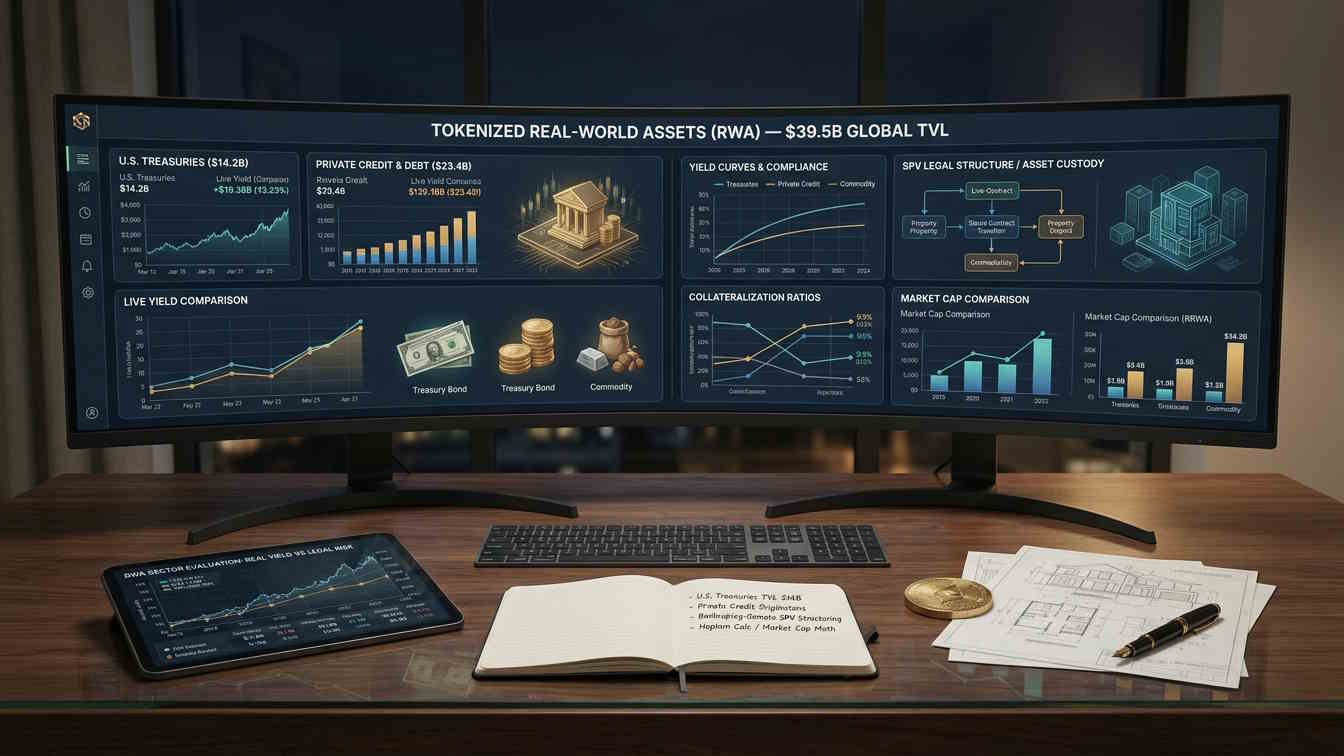
While speculative altcoins have struggled for traction during the sideways market of late 2026, tokenized real-world assets (RWAs) have quietly become one of the most resilient sectors in crypto. Across public blockchains, distributed RWA value has expanded to roughly $39.5 billion (excluding stablecoins), driven primarily by tokenized U.S. Treasuries at around $14 billion and on-chain private credit ranging from $8 billion on public trackers to over $23 billion when broader platform-locked originations are included.
When retail appetite cools and pure momentum trades dry up, capital naturally rotates toward assets backed by verifiable off-chain cash flows. Yet not every protocol slapping "RWA" into its pitch deck offers genuine yield or enforceable legal rights. Evaluating RWA tokens in late 2026 requires looking past headline APYs and examining legal plumbing, liquidity bottlenecks, and realistic token valuations.
The first rule of researching any RWA protocol is tracing the exact source of its yield. Sustainable on-chain yield does not appear out of thin air—it mirrors traditional fixed-income risk tiers:
If a smaller RWA protocol promises 20%+ "risk-free" yield on government bonds, the extra return is almost certainly coming from inflationary token emissions rather than off-chain assets.
A blockchain token is only as strong as the legal claim connecting it to the underlying asset. Before allocating capital, verify how ownership is structured off-chain:
One of the biggest traps in RWA investing is confusing a protocol's Total Value Locked (TVL) with the value of its governance token.
First, examine secondary market liquidity. Industry data from 2026 shows that the vast majority of tokenized RWA supply sits idle in institutional wallets, and less than 10% is actively integrated into DeFi lending or liquidity pools. During stressed market weeks, thinly traded RWA tokens can briefly trade at a discount to Net Asset Value (NAV) if redemptions take days to settle.
Second, separate the yield-bearing product from the protocol governance token. For example, while Ondo Finance scaled past $3.7 billion to $4 billion in TVL across its Treasury and tokenized stock products in late 2026, its public ONDO token has historically functioned primarily as a governance asset with multi-year unlock schedules extending toward 2029. Always verify whether protocol fees flow back to token holders or remain strictly at the corporate equity level.
Because RWA is a major institutional narrative, emerging mid-cap and low-cap RWA projects frequently launch with inflated valuations. Before buying an ecosystem token, run two practical checks:
| Feature | Tokenized U.S. Treasuries | Tokenized Private Credit |
|---|---|---|
| Market Scale (Nov 2026) | ~$14.0B–$14.3B distributed value | $8.2B distributed ($23B+ broad counts) |
| Typical Yield Range | ~3.5% to 4.5% APY | ~8% to 15% APY |
| Primary Risk Profile | Interest rate changes and custodial/smart-contract risk | Borrower default risk, lockups, and thin secondary liquidity |
| Major Benchmarks | Ondo (USDY), Circle (USYC), BlackRock (BUIDL), Franklin Templeton (BENJI) | Figure, Clearpool, Goldfinch |
Why are tokenized real-world assets growing during a slow crypto market in late 2026? When speculative trading cools, investors seek predictable, off-chain yield backed by U.S. government debt, private loans, and commodities rather than relying purely on token price appreciation.
Are tokenized Treasury tokens completely risk-free? No. While underlying U.S. Treasury bills carry low credit risk, holders still face smart-contract risk, custodial and SPV legal execution risk, and potential secondary market liquidity delays during high-volatility periods.
Does high RWA TVL automatically make a protocol's native token go up? Not necessarily. Many RWA issuers generate revenue for corporate shareholders or reserve yield strictly for asset depositors, leaving native governance tokens without direct fee-sharing mechanisms.
Tokenized real-world assets represent one of the clearest bridges between traditional finance and public blockchains, with distributed value nearly doubling over the past year. Approaching the sector with a strict focus on yield sources, bankruptcy-remote legal structures, liquidity depth, and grounded valuation math ensures you invest in real cash flows rather than repackaged hype.
Want your project featured here?
List your crypto project in weekly community rankings. One-time $99 — ranked forever. Top projects get editorial coverage and 20+ social posts/week.
List My Project — $99